Dear Recruiters & Hiring Managers:
Stop Overlooking People Like Me
I want to talk to you directly. Not as a job seeker performing enthusiasm for an ATS. Not as a LinkedIn connection trying to work my way into your calendar. As a peer — someone who has sat on your side of the desk for over 12 years — I want to have an honest conversation about what’s happening out there. And why it needs to stop.
Because here’s the truth: you are screening out some of the best talent in the market. And you are doing it before a human being ever lays eyes on their resume.
Let Me Tell You Where I Am Right Now
I’m middle age — and I mean that the way it’s supposed to sound: I’m in my prime. Not winding down. Not coasting. Not counting the years until I can collect a pension and disappear into my garden. I am fully in it.
My kids are grown. The tuition payments are done. The frantic years of juggling career advancement with school pickups and Saturday soccer games — behind me. What that means for you, as a hiring manager or recruiter, is that you are looking at someone whose priorities have clarified in a way that only comes with time. I am not chasing a title. I am not here to impress my parents or prove something to an ex-boss. I am here to do the best work of my life. And that is a very different kind of candidate than the one you think I am.
For the first time in a long time, I’m not chasing a paycheck. I’m chasing purpose. I want to build something that matters, contribute to a team that values what I bring, and leave a role better than I found it. If that doesn’t sound like someone worth an interview, I genuinely don’t know what does.
Here’s What You’re Actually Filtering Out
When your ATS buries my resume because my graduation year makes the math uncomfortable — when your job posting says “digital native” and means “not you” — when your recruiter screens me out after a 10-minute phone call because I have too much experience for a role I’m genuinely excited about — you are not protecting your organization from a bad hire. You are making one.
You’re passing on candidates who bring things that cannot be fast-tracked. Things that don’t appear in a skills section or a LinkedIn badge. Things that take years — sometimes decades — to develop:
- Experience — not just time served, but pattern recognition. I’ve seen how this plays out. I know where the risks are before they become crises.
- Perspective — I’ve worked across functions, industries, and economic cycles. I know that the problem on the surface is rarely the actual problem.
- Emotional intelligence — I’ve navigated difficult managers, complex stakeholders, and high-stakes decisions. I don’t get rattled. I get strategic.
- Steady leadership in chaotic times — I have managed through a recession, a global pandemic, mass layoffs, and market pivots. Chaos is not new territory for me.
- Loyalty that doesn’t disappear at the first recruiter message — I’m not here as a stepping stone. I’m here because I chose to be here. That distinction matters more than you might think.
I Know What You’re Thinking. Let Me Address It Directly.
You’re thinking about salary expectations. You’re wondering if I’ll be set in my ways. You’re asking yourself whether I’ll struggle with the tech stack, whether I’ll resent a younger manager, whether I’ll leave the moment something better comes along.
I know you’re thinking these things because I used to think them too. I sat in those debrief rooms. I watched candidates get screened out for reasons that had nothing to do with their ability to do the job. I’ve heard “culture fit” used as a clean exit from a conversation nobody wanted to have out loud.
And then I found myself on the other side of that process. And I understood, viscerally, how expensive those assumptions are — for the candidate, yes, but also for the organization doing the filtering.
“Tenured talent isn’t a risk. It’s a return on investment that younger organizations haven’t learned to price correctly yet.”
So let me answer the assumptions directly:
On salary: I’m not asking you to overpay me. I’m asking you to pay me fairly for what I bring. Those are different conversations, and most hiring managers conflate them.
On tech: I use AI tools in my work every day. I’ve adapted to more technology shifts than most of your current employees have lived through. Adaptability isn’t a function of age — it’s a function of mindset. Mine is growth-oriented.
On younger managers: I’ve worked for people half my age and learned something from every one of them. Leadership is about clarity and trust, not hierarchy. I’m not threatened by talent. I’m energized by it.
On retention: I’m not looking for a stepping stone. I’m looking for the right fit. When I find it, I stay. That’s not a liability. That’s a feature.
We Are Not Burned Out. We Are Fired Up.
I want to push back on the narrative, because it does real damage. The story that experienced professionals are coasting toward retirement, that we’ve peaked, that we’re resistant to change, that we’re too expensive and too slow and too set in our ways — it is wrong. And it is costing organizations the kind of talent that doesn’t get rebuilt from scratch.
We are not burned out. We know the difference between a long career and a tired one, and we know which one we’re in.
We don’t need hand-holding. We’ve held the line through recessions, mass layoffs, market crashes, and organizational chaos. We know how to operate without a playbook because we helped write the playbook.
We don’t want to run the show. We want to make the show better. There is a category of professional — experienced, skilled, self-aware — who has done the ego work. Who doesn’t need the title to feel validated. Who shows up to contribute, not to compete. That is a rare thing. And you’re filtering it out.
What I’m Actually Asking For
Stop making assumptions before you’ve had a real conversation. Stop letting an ATS make hiring decisions that a human being should be making. Stop using “culture fit” as a shortcut for a bias you haven’t examined.
Start seeing the full picture of what experience actually looks like in a candidate. Start asking different questions — not “where do you see yourself in five years” but “what’s the hardest problem you’ve ever solved and how did you do it.” Start treating tenured professionals as the strategic asset they are, not the liability you’ve been conditioned to see.
If you’re ready to stop assuming and start seeing — let’s talk.
I bring wisdom, not rust. I bring perspective earned through real experience in this exact industry, on both sides of this exact desk. I bring the kind of steady, strategic contribution that doesn’t require a lengthy ramp-up because I’ve been ramping up my entire career.
I’m not winding down. I’m just getting started.
— Angela Malagon
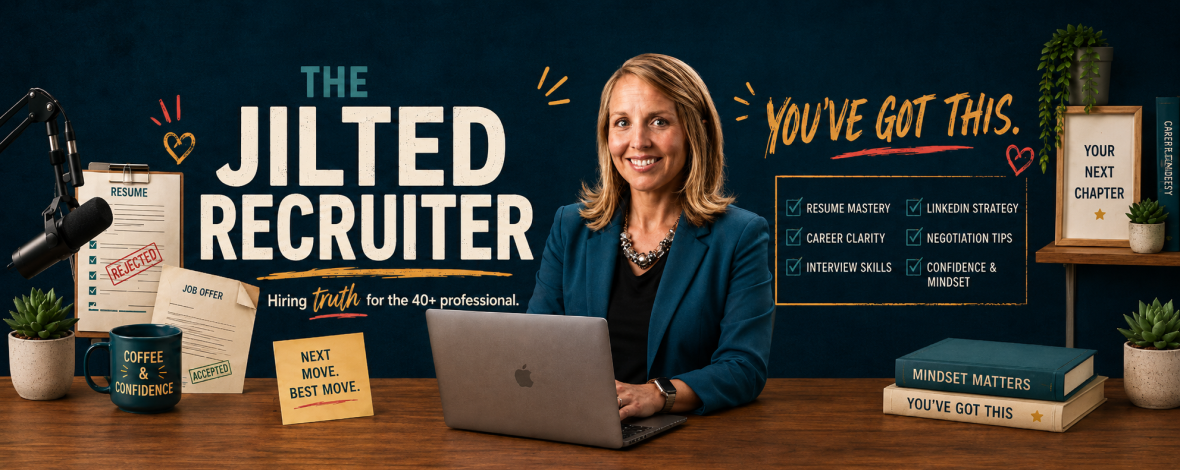
The Jilted Recruiter
A Note to the Professionals Reading This
If you’re a business professional over 40 navigating a market that keeps sending you signals that your experience is a problem — I want you to hear this clearly: the market is broken. You are not.
The professionals who get through this are not the ones who shrink. They’re the ones who refuse to internalize the bias. They adjust their strategy without adjusting their self-worth. They document, they reframe, they leverage their network, and they keep going.
Your 20 years of experience is an asset. The hiring process is failing to measure it correctly. That is a system problem, not a you problem — and there are strategies to work around it.
That’s what The Jilted Recruiter is here for.