Recruiting Tips

How to Be a Great Recruiter: Skills, Mindset, and Habits That Set You Apart

Recruiting isn’t just about filling jobs. It’s about building relationships, understanding people, and connecting the right talent to the right opportunity at the right time. A great recruiter isn’t measured solely by how fast they can close a role but by the quality of their hires, the trust they build, and the long-term impact they have on an organization’s success.

Whether you’re new to recruiting or a seasoned pro, here are the pillars that separate good recruiters from great ones:


1. Master the Art of Listening

The best recruiters talk less than they listen. This means:

  • Asking open-ended questions.
  • Understanding both what the candidate says and what they mean.
  • Listening to hiring managers beyond the job description to uncover what they truly need.

When you listen deeply, you can match skills, personalities, and career goals in a way that drives retention and satisfaction.


2. Be a Relationship Builder, Not a Transaction Closer

Recruiting is about people, not just positions. Great recruiters:

  • Stay connected with candidates even after they’ve landed a job.
  • Keep in touch with hiring managers between openings.
  • Build a talent pipeline before it’s needed.

When trust is your currency, people remember you — and they’ll call you first when they’re ready for their next move or have a hiring need.


3. Understand the Business Inside and Out

A recruiter who knows the company’s industry, products, challenges, and competitors will:

  • Ask smarter screening questions.
  • Better align hires with strategic goals.
  • Earn the respect of hiring managers as a true partner, not just a service provider.

4. Balance Speed with Quality

Speed matters — hiring managers don’t like empty seats. But great recruiters don’t sacrifice quality for the sake of quick wins.

  • Use data to track time-to-fill and quality-of-hire.
  • Present well-vetted candidates, not just anyone who looks good on paper.

Remember: a fast hire who fails costs more than taking a little extra time to find the right fit.


5. Be a Champion for Diversity, Equity, and Inclusion (DEI)

A great recruiter actively works to remove bias from the hiring process. That means:

  • Sourcing from diverse talent pools.
  • Using inclusive language in job descriptions.
  • Educating hiring teams on equitable hiring practices.

Inclusive hiring isn’t just the right thing to do — it’s a business advantage.


6. Leverage Technology, But Stay Human

AI sourcing tools, applicant tracking systems, and recruitment marketing platforms can save time — but they’re not a substitute for the human touch.

  • Use tech to automate repetitive tasks.
  • Spend freed-up time on relationship-building, market research, and candidate engagement.

7. Keep Learning and Adapting

The job market changes fast — skills in demand today may be outdated tomorrow.

  • Stay on top of hiring trends and salary benchmarks.
  • Learn new sourcing strategies.
  • Invest in professional development to stay sharp.

8. Be Transparent and Communicative

One of the biggest complaints from candidates is ghosting. Great recruiters:

  • Keep candidates updated, even if there’s no news.
  • Give constructive feedback when possible.
  • Set realistic expectations on timelines and next steps.

A little communication goes a long way in building your reputation.


Final Thoughts

A great recruiter is part detective, part salesperson, part coach, and part cheerleader. They’re curious, empathetic, strategic, and relentless in the pursuit of matching the right talent to the right opportunity.

If you want to stand out in recruiting, focus on the people, the process, and your own professional growth. That’s the real secret to long-term success.

Recruiting Tips

How Recruiters Can Successfully Pivot Their Careers

From Talent Scouts to Strategic Powerhouses: Making the Shift with Transferable Skills


Recruiting is more than just filling jobs—it’s relationship building, strategic thinking, data analysis, marketing, and storytelling rolled into one. So what happens when a recruiter wants to make a career pivot? The good news is: you’re already armed with a powerhouse of transferable skills.

Whether you’re burned out from chasing reqs or ready to explore new challenges, recruiters are uniquely positioned to pivot into a wide range of roles across HR, operations, marketing, sales, and more.

Here’s how recruiters can make a successful career shift—and where your skills can take you.


🎯 First, Let’s Talk Transferable Skills

Recruiters wear many hats, often without even realizing how versatile their toolkit is. Here’s a breakdown of recruiter skills that apply across industries:

  • Stakeholder Management: Collaborating with hiring managers? That’s project management and client service experience.
  • Data Literacy: Analyzing time-to-fill, pipeline conversion, and source effectiveness? That’s analytics and business intelligence.
  • Sourcing + Research: Boolean searches and candidate deep-dives? That’s market research and investigative prowess.
  • Employer Branding: Crafting job descriptions and marketing roles? You’ve been in marketing this whole time.
  • CRM/ATS Tools: Familiar with systems like iCIMS, Workday, Greenhouse, or LinkedIn Recruiter? You’re already fluent in modern tech stacks.
  • Negotiation & Influence: Convincing a candidate to accept an offer and a hiring manager to compromise? That’s sales and stakeholder alignment.
  • Process Improvement: Streamlining interview workflows? You’ve been in operations all along.

🌱 Potential Career Paths for Recruiters Looking to Pivot

Here are some popular directions recruiters can grow into—without starting from scratch:

1. People Operations / HR Generalist

If you enjoy shaping the employee experience beyond the interview process, people ops is a natural move. You’ll use your stakeholder engagement, onboarding, and compliance knowledge to drive employee engagement and HR programs.

2. Talent Development / L&D

Love coaching candidates and helping them grow? Learning & Development could be a great fit. You already understand career paths, skills development, and how people learn.

3. Project or Program Management

Recruiters juggle req loads, timelines, and conflicting priorities daily—that’s classic project management. If you’re organized and data-driven, formalizing those skills through a PM role (or CAPM/PMP certification) could unlock major opportunities.

4. Marketing (Content or Employer Branding)

Recruiters are brand storytellers. If you enjoy writing job ads, managing social posts, or crafting outreach campaigns, a pivot into marketing, especially employer branding or content creation, could be seamless.

5. Customer Success or Sales

You’re already selling roles to candidates. Why not sell products or services? Recruiters with strong interpersonal skills and solution-oriented thinking thrive in client-facing sales or customer success roles.

6. Diversity, Equity & Inclusion (DEI)

If you’ve been driving inclusive hiring practices, a move into DEI allows you to scale that impact across the entire employee lifecycle.

7. HR Tech / Talent SaaS

Worked with tools like Greenhouse, Eightfold, or Beamery? Many recruiting platforms need customer advocates, implementation specialists, or product managers who deeply understand the recruiter’s experience.


🧭 Tips for Making the Pivot

  • Audit Your Skills: Use a tool like a skills matrix to map what you do today to what’s needed in your target role.
  • Upskill Where Needed: A short course on SQL, digital marketing, or agile PM can bridge the gap.
  • Tell a Compelling Story: Frame your pivot as a natural progression—not a departure. Highlight the impact you’ve made and how those skills apply in new contexts.
  • Rebrand Your Resume + LinkedIn: Tailor your profile and resume with the new career in mind. Swap out “recruiter-speak” for industry-aligned terms in your desired field.
  • Leverage Your Network: Use your sourcing skills on yourself—reach out, set up chats, and ask for referrals or advice from people in your target role.

💡 Final Thought: You’re Not Starting Over

Recruiters are uniquely equipped to pivot because we already operate at the intersection of people, data, and business strategy. Your next career move isn’t a leap—it’s a pivot built on a strong foundation of impact and insight.

You’ve helped hundreds of people land the right roles. Now it’s time to do the same for yourself.


Ready to pivot? Share in the comments what path you’re exploring, and let’s crowdsource support for recruiter career changers. 💼✨


Recruiting Tips

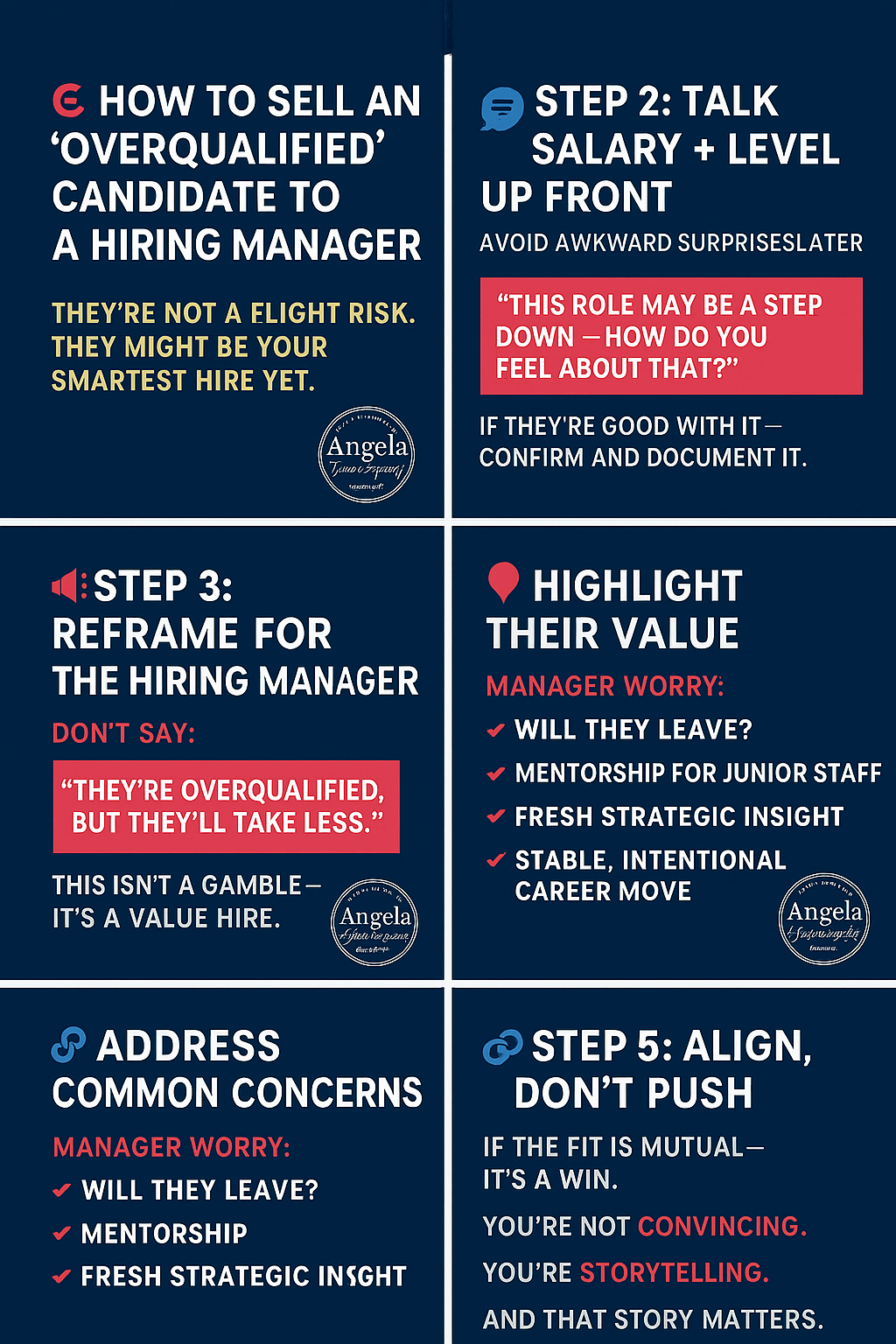
How to Sell an “Overqualified” Candidate to a Hiring Manager (and Why You Should)


As recruiters and talent advisors, we often hear a dreaded word when presenting experienced talent:

“They’re overqualified.”

Translation?
The hiring manager is concerned the candidate will get bored, won’t stick around, or is simply too expensive. But what if that “overqualified” label is actually a strategic advantage?

Here’s how to shift that narrative—and how to have the right conversation with the candidate to make sure everyone’s aligned before moving forward.


Step 1: Get Clear on the Candidate’s “Why”

Before you pitch a seasoned professional for a role that might look like a step back on paper, have an honest, empathetic conversation:

Ask the candidate:

  • What’s motivating you to consider this role right now?
  • How do you feel about the level/title compared to your last role?
  • What are your salary expectations? Are they flexible?
  • Are you looking for stability, mentorship opportunities, reduced stress, or a better work-life balance?

Many experienced professionals are making intentional decisions:

  • They’ve led large teams and now want to be individual contributors again.
  • They’ve done the high-travel, high-stress gig and want something more balanced.
  • They’ve had personal life changes that shift their priorities.
  • They want to align their work with a mission or product they care about.

Your goal? Understand why this role, now—and make sure their reasons are clear, realistic, and sustainable.


Step 2: Address Salary and Level Up Front

Here’s where things can get awkward if you avoid it—but powerful if you don’t.

Be direct:

“This role may come in under what you’ve made previously. Can you share what your current salary expectations are and how flexible you’re willing to be?”

If they’re open to a lower salary or step down in title, get that in writing (at least noted in your ATS). Transparency now prevents surprises later.

Be cautious if the candidate says “I’ll take anything”—dig deeper. Make sure the motivation aligns, or you risk a short-term hire.


Step 3: Reframe the Narrative for the Hiring Manager

Now that you’re clear on the candidate’s motivation and expectations, it’s time to present them strategically.

Don’t say:

“They’re overqualified, but willing to take less.”

Do say:

“This candidate brings deep expertise, but what excites them most is returning to hands-on work. They’re looking for a role where they can make an immediate impact without managing a large team or chasing titles.”

Focus on:

  • Speed to productivity: They’ve done this before—no steep learning curve.
  • Mentorship capacity: Great for junior team development.
  • Stability: If they’re shifting gears in life/career, they may stay longer than someone climbing the ladder.
  • Strategic value: They can bring insights that go beyond the current role.

💡 Pro tip: Position this as a “value hire,” not a compromise. You’re getting premium expertise at a practical cost.


Step 4: Tackle Concerns Proactively

Hiring managers often worry that the candidate:

  • Will leave as soon as something better comes along
  • Will struggle to take direction from a less experienced manager
  • Will be bored or disengaged

Here’s how to ease those concerns:

  • “We talked about that. They’re clear on their motivations, and they specifically want to contribute without being in charge.”
  • “They’ve worked under all kinds of leaders—they’re looking for collaboration, not control.”
  • “They’ve seen how stressful leadership can be. They want to focus on meaningful work and mentorship.”

Step 5: Align, Don’t Push

At the end of the day, the goal is alignment—not persuasion. If both sides are genuinely excited and aligned in expectations, it’s a win.

When handled right, “overqualified” becomes “highly qualified,” and what seemed like a risk becomes a strategic advantage.


Final Thought:

Don’t screen out someone just because they’ve done more.
Have the conversation. Ask the right questions.
Then present the right story to your hiring manager.

Because sometimes the best hire… isn’t the one climbing up—it’s the one who’s already been there and knows exactly what they want next.