Recruiting Tips

Stop Overlooking Tenured Talent: We’re Not Washed Up—We’re Just Getting Started

I’m 45.

My kids are grown. College tuition is paid. The backpacks and parent-teacher conferences are behind me.

And for the first time in a long time, I’m not choosing jobs based on salary alone.

I’m choosing purpose.

This shift didn’t happen overnight—it came with time, perspective, and a whole lot of life experience. But now, I’m in a place where I want to bring my knowledge, my passion, and my fire to work that matters. I want to be part of a team where I can leave things better than I found them.

And yet, I keep running into the same wall—one built on assumptions.

When recruiters or hiring managers see a resume with 20+ years of experience, I know what some of them are thinking:
“Too senior for this role.”
“Probably wants too much money.”
“Won’t adapt to a younger team.”
“Might not be up to speed with tech.”

Let me set the record straight.

📌 I’m not chasing titles—I’m chasing impact.
📌 I’m not stuck in my ways—I’ve led through change.
📌 I’m not behind on tech—I’ve adapted through every digital evolution of the workplace.
📌 I’m not a flight risk—I’m looking for roots, not rungs.

Let’s talk about what seasoned professionals bring to the table that can’t be taught in a crash course:

  • Emotional intelligence sharpened through decades of real-world leadership.
  • The ability to remain calm and strategic in the face of uncertainty.
  • A long view of business, teams, and trends.
  • The mentorship mindset—invested in the success of others, not just ourselves.

We’ve navigated economic downturns, workplace transformations, and massive cultural shifts—and we’ve stayed standing. We’re not burnt out—we’re fired up. We’re ready to roll up our sleeves and get to work, not to micromanage or hoard power.

Tenured talent isn’t a risk—it’s a return on investment.

So, to the recruiters and hiring managers out there:
If you stop assuming and start listening, you’ll discover a candidate pool full of wisdom, resilience, and purpose.

We’re not looking for the next step up. We’re looking for the next place to pour into.

And we’re just getting started.

Recruiting Tips

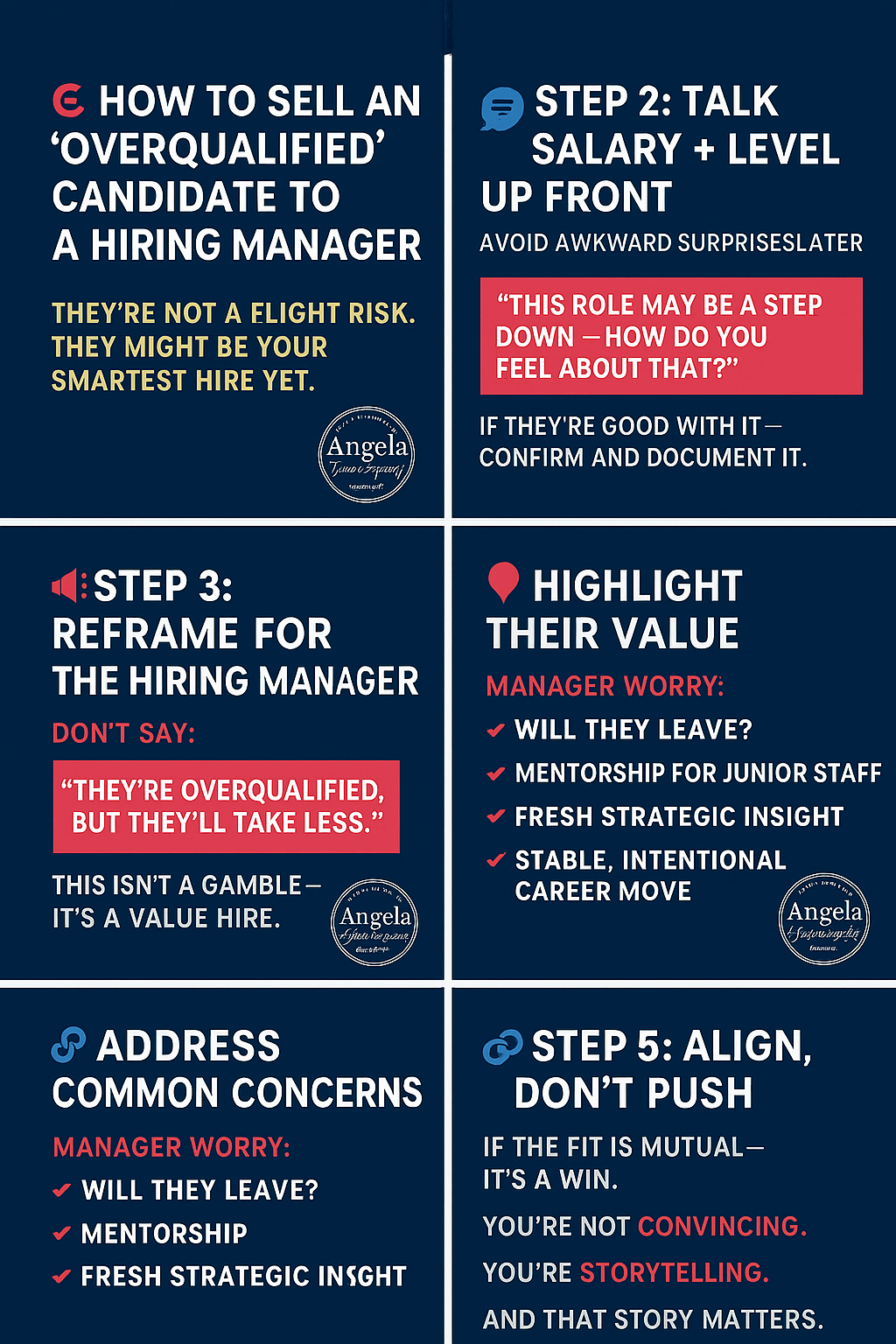
How to Sell an “Overqualified” Candidate to a Hiring Manager (and Why You Should)


As recruiters and talent advisors, we often hear a dreaded word when presenting experienced talent:

“They’re overqualified.”

Translation?
The hiring manager is concerned the candidate will get bored, won’t stick around, or is simply too expensive. But what if that “overqualified” label is actually a strategic advantage?

Here’s how to shift that narrative—and how to have the right conversation with the candidate to make sure everyone’s aligned before moving forward.


Step 1: Get Clear on the Candidate’s “Why”

Before you pitch a seasoned professional for a role that might look like a step back on paper, have an honest, empathetic conversation:

Ask the candidate:

  • What’s motivating you to consider this role right now?
  • How do you feel about the level/title compared to your last role?
  • What are your salary expectations? Are they flexible?
  • Are you looking for stability, mentorship opportunities, reduced stress, or a better work-life balance?

Many experienced professionals are making intentional decisions:

  • They’ve led large teams and now want to be individual contributors again.
  • They’ve done the high-travel, high-stress gig and want something more balanced.
  • They’ve had personal life changes that shift their priorities.
  • They want to align their work with a mission or product they care about.

Your goal? Understand why this role, now—and make sure their reasons are clear, realistic, and sustainable.


Step 2: Address Salary and Level Up Front

Here’s where things can get awkward if you avoid it—but powerful if you don’t.

Be direct:

“This role may come in under what you’ve made previously. Can you share what your current salary expectations are and how flexible you’re willing to be?”

If they’re open to a lower salary or step down in title, get that in writing (at least noted in your ATS). Transparency now prevents surprises later.

Be cautious if the candidate says “I’ll take anything”—dig deeper. Make sure the motivation aligns, or you risk a short-term hire.


Step 3: Reframe the Narrative for the Hiring Manager

Now that you’re clear on the candidate’s motivation and expectations, it’s time to present them strategically.

Don’t say:

“They’re overqualified, but willing to take less.”

Do say:

“This candidate brings deep expertise, but what excites them most is returning to hands-on work. They’re looking for a role where they can make an immediate impact without managing a large team or chasing titles.”

Focus on:

  • Speed to productivity: They’ve done this before—no steep learning curve.
  • Mentorship capacity: Great for junior team development.
  • Stability: If they’re shifting gears in life/career, they may stay longer than someone climbing the ladder.
  • Strategic value: They can bring insights that go beyond the current role.

💡 Pro tip: Position this as a “value hire,” not a compromise. You’re getting premium expertise at a practical cost.


Step 4: Tackle Concerns Proactively

Hiring managers often worry that the candidate:

  • Will leave as soon as something better comes along
  • Will struggle to take direction from a less experienced manager
  • Will be bored or disengaged

Here’s how to ease those concerns:

  • “We talked about that. They’re clear on their motivations, and they specifically want to contribute without being in charge.”
  • “They’ve worked under all kinds of leaders—they’re looking for collaboration, not control.”
  • “They’ve seen how stressful leadership can be. They want to focus on meaningful work and mentorship.”

Step 5: Align, Don’t Push

At the end of the day, the goal is alignment—not persuasion. If both sides are genuinely excited and aligned in expectations, it’s a win.

When handled right, “overqualified” becomes “highly qualified,” and what seemed like a risk becomes a strategic advantage.


Final Thought:

Don’t screen out someone just because they’ve done more.
Have the conversation. Ask the right questions.
Then present the right story to your hiring manager.

Because sometimes the best hire… isn’t the one climbing up—it’s the one who’s already been there and knows exactly what they want next.