

Definition & Examples of a Career Path

We’ll review types and examples of career paths and how to develop a career path.
What Is a Career Path?
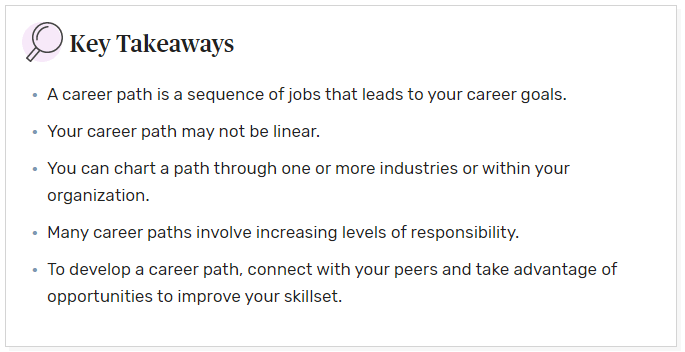
A career path is a series of jobs that help you progress towards your goals and objectives.
Your career path includes the jobs you’ll need to hit your ultimate career goal, but it doesn’t need to follow a straight line. There’s no blueprint or timetable for climbing the career ladder.
Career paths traditionally imply vertical growth or advancement to higher-level positions, but they can also include lateral (sideways) movement within or across industries.1
A Bureau of Labor Statistics survey of baby boomers found that they had an average of 12.3 jobs from ages 18 to 52.2 Changing jobs is expected, and sometimes those changes will involve different types of positions in various industries. Some career paths have a few ups and downs and some people even plan a move down the career ladder.
You might move down the career ladder by asking your company for a transfer to a position with fewer responsibilities and less stress. Or you might apply for a position with a company that you’re passionate about working with, but the only available positions are lower level ones.3
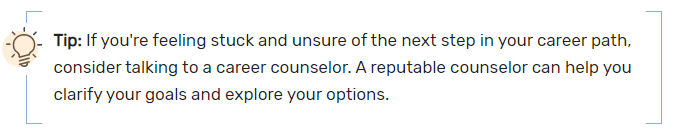
If you’re feeling stuck and unsure of the next step in your career path, consider talking to a career counselor. A reputable counselor can help you clarify your goals and explore your options.
Types of Career Paths
Career paths typically refer to either your path through an industry or your path through an organization. For example, if your goal is to become a principal, you’d typically start as a teacher and work on your administrative credentials while teaching. If you’re in a large district, you might chart a path within your district. You might become a department head and then advance to a position as an assistant principal.
If you’re in a smaller district, you might need to move to a different organization to advance your goals. In that case, your advancing within your profession, but moving to another organization.
Some organizations help you develop a career path as part of the employee development process.4 In this case, you and your supervisor or a human resources representative discuss your career development within your organization.
This discussion may take place as part of the performance appraisal process. Additional education, training, or work assignments may be planned to qualify you for subsequent roles within your career path.
Ultimately, your career path depends on your career values and personal goals. You might change industries as you pursue a higher income, better benefits, and/or increased job satisfaction. Or, you might wander off the path altogether to take care of family or continue your education.
Examples of Career Paths
To get a sense of your options, it helps to review examples of career paths for a variety of fields. Keep in mind that some career paths are direct and include specific jobs that move you up the career ladder and are typically followed in order.
Here are several examples:
- Administration: Administrative Assistant—Executive Assistant—Office Manager
- Advertising: Advertising Account Coordinator—Assistant Account Executive—Account Executive—Senior Account Executive
- Communications: Public Relations Assistant—Public Relations Representative—Assistant Director of Public Relations—Director of Communications
- Customer service: Customer Service Representative—Inside Salesperson —Outside Salesperson—Major Account Salesperson—Regional Sales Manager
- Editorial: Editorial Assistant—Assistant Editor—Associate Editor—Editor—Senior Editor—Editorial Director
- Education: Teacher—Curriculum Coordinator—Assistant Principal—Principal
- Education to insurance (career change): Teacher—Insurance Salesperson—Trainer for New Agents
- Engineering: Junior Engineer—Senior Engineer—Project Manager—Engineering Consultant
- Human resources: Human Resources Assistant—Benefits Assistant—Benefits Specialist—Assistant Director of Human Resources—Director of Human Resources
- Retail: Retail Sales Clerk—Assistant Manager—Department Manager—Store Manager—Regional Manager
Requirements for a Career Path
Some people have deliberate, well-planned career paths. Others take things one job at a time, adjusting as their goals and preferences change. Either approach (or a combination of the two) can be successful. Here are a few ways you can position yourself for a successful career path:
- Be in learning mode: Today’s job market moves quickly. To keep up, you need to be prepared to add to your skillset. To find out which skills are most in demand in your industry, take a look at your peers’ LinkedIn profiles. You’ll learn which skills you’ll need to advance.
- Network: Connecting with your peers can help you identify new directions for your career, even if you’re not interested in job-hopping at the moment.
- Be flexible: Don’t hold too tightly to your career plan. Be open to opportunity and keep your ultimate goals in mind. What’s important to you? What do you enjoy about your job and career, and what would you prefer to minimize at your next gig?
- Don’t be afraid of a lateral move: Sometimes you need to move sideways (or even backward) to get ahead. If a job offers you a chance to develop skills or connections that will be valuable later on, be open to a lateral move.

 Angela Malagon