Recruiting Tips

How to Deal with Setbacks in Your Career (Without Letting Them Define You)

Blog Title: How to Deal with Setbacks in Your Career (Without Letting Them Define You)

Setbacks are inevitable. Whether it’s getting passed over for a promotion, being laid off, receiving negative feedback, or simply feeling stuck—career detours happen to everyone. But while we can’t always control what happens, we can control how we respond.

Here’s how to deal with career setbacks in a way that helps you bounce back stronger, smarter, and more self-aware:


🔁 1. Pause and Process (Don’t Pretend It Didn’t Happen)

First, acknowledge the setback. Allow yourself to feel whatever emotions come up—disappointment, frustration, even anger. Suppressing it won’t make it go away, but processing it will help you move forward with clarity.

Pro tip: Journal about it, vent to a trusted friend, or talk to a mentor. Give your feelings a place to land.


🧠 2. Reframe the Narrative

Instead of asking “Why is this happening to me?” ask, “What can I learn from this?”

Maybe this job wasn’t aligned with your long-term goals. Maybe you needed the push to explore a new industry. A setback can be a setup for a comeback—if you’re willing to shift perspective.


🛠️ 3. Do a Career Audit

Use the moment to reassess. Ask yourself:

  • Am I happy in this field?
  • What skills do I want to grow?
  • Where do I feel underutilized or stuck?

Sometimes the setback reveals a misalignment between where you are and where you want to go.


🧩 4. Rebuild with Intention

Once you’ve taken stock, it’s time to rebuild. That might mean:

  • Upskilling through courses or certifications
  • Networking more intentionally
  • Updating your resume and LinkedIn
  • Seeking out a career coach or mentor

Make small, consistent moves toward your next chapter—even if you’re not sure what it is yet.


💬 5. Talk About It (Strategically)

If you’re interviewing or networking, be honest about your setback—but frame it in terms of growth. Hiring managers don’t expect perfection. They want resilience.

Example:
“After being laid off, I used that time to complete a project management certification and reconnect with what energizes me about leading teams.”


💡 6. Remember: Setbacks Aren’t a Sign of Failure

They’re a sign you’ve been trying. Every successful person you admire has faced rejection, self-doubt, and failure. What sets them apart? They kept going.


🧭 Final Thought: Your Career Is Not a Straight Line

It’s a journey with detours, dead ends, and surprising shortcuts. A setback doesn’t erase your skills, your value, or your worth. It’s just one chapter—not your whole story.

So take a breath, regroup, and remind yourself: this is a plot twist, not the end.


Ready to bounce back?
Let setbacks fuel your next move. You’ve got this.


Recruiting Tips

Neurodivergent vs. Neurotypical candidates. Advice for leading a successful job interview

Here’s a concise guide with advice for leading a successful job interview that supports both neurodivergent and neurotypical candidates — helping create an equitable, inclusive, and effective interview experience.


💡 Why It Matters

Neurodivergent individuals (e.g., ADHD, autism, dyslexia, etc.) may process information, communicate, or experience sensory input differently. Traditional interviews often favor neurotypical thinking and behavior, unintentionally creating barriers to talent.


Interview Best Practices for All Candidates — with Neurodiversity in Mind

1. Structure the Interview

  • 📅 Send an agenda in advance.
  • 🧠 Outline what to expect: topics, format, and who will be present.
  • ⏳ Allow time for processing; avoid rapid-fire questions.

Why? Neurodivergent candidates often thrive with predictability and preparation.


2. Be Clear, Not Vague

  • ✅ Ask direct, specific questions.
  • ❌ Avoid abstract behavioral prompts like “Tell me about a time you had a conflict with a coworker” unless you explain what you’re looking for.

Tip: Rephrase as, “Can you describe how you usually handle disagreements on a team project?”


3. Offer Flexibility

  • 🧍‍♂️ In-person, remote, or camera-off options when possible.
  • 🗣 Allow written or visual responses for tasks if preferred.

Why? Sensory or social differences may make certain environments or formats more challenging for some neurodivergent candidates.


4. Normalize Accommodations

  • Include a statement like:
    “If you need any accommodations during the interview process, please let us know — we want to set you up for success.”

Make it standard — not something that requires disclosure of diagnosis.


5. Rethink “Culture Fit”

  • 🧩 Prioritize values alignment and working style compatibility over shared hobbies or personality traits.
  • 🚩 Watch for bias disguised as “gut feeling.”

Remember: Diversity of thought leads to stronger teams.


6. Assess the Work — Not the Performance

  • Use work samples, skills-based questions, or job simulations instead of relying solely on conversational prowess or small talk.

Why? Many neurodivergent candidates may not “perform” traditionally but can excel in the role.


7. Bias Awareness Training

  • Train interviewers to recognize bias around eye contact, tone of voice, pacing, or fidgeting — these aren’t indicators of competence.

Your job: Evaluate skills, not social scripts.


🌱 Final Thought

Hiring inclusively doesn’t lower the bar — it removes unnecessary barriers so you can access untapped talent.


interview, Recruiting Tips

Nail the Interview: Insider Tips to Stand Out and Get the Offer


Nail the Interview: Insider Tips to Stand Out and Get the Offer

You’ve applied, you’ve waited, and now you’ve got the interview. Great news! But how do you go from “We’ll let you know” to “When can you start?”

As a Talent Acquisition professional, I’ve sat on both sides of the interview table—and here’s what I know for sure: interviews are less about perfection and more about preparation, presence, and personality.

Whether it’s your first interview or your 50th, here are 10 tips to help you shine:


✅ 1. Do Your Homework

Research the company’s mission, values, recent news, and competitors. Understand the job description inside and out. Know how your skills align and be ready to talk about it.

Bonus tip: Google the interviewer. A little insight into their background can help you connect authentically.


✅ 2. Know Your Story

Be able to walk someone through your resume without rambling. Use the “Present-Past-Future” format:

  • Present: What are you doing now?
  • Past: What’s your relevant experience?
  • Future: Why this job, and why now?

✅ 3. STAR Your Examples

Behavioral questions (“Tell me about a time when…”) are common. Use the STAR method:

  • Situation
  • Task
  • Action
  • Result

Keep it concise. Practice a few go-to stories ahead of time.


✅ 4. Dress for the Culture

If it’s a video call, test your tech, lighting, and background. Even in casual environments, showing up professionally (yes, even virtually) signals respect and intention.


✅ 5. Ask Thoughtful Questions

This is not just about them interviewing you. Come with 2–3 questions that show curiosity and strategic thinking. Try:

  • What does success look like in this role in the first 90 days?
  • How does this team handle challenges or change?
  • What do you love about working here?

✅ 6. Speak to Impact, Not Just Duties

Don’t just say what you did. Explain the impact of what you did:

  • “I led weekly reports” → “My reporting helped leadership make faster decisions, which reduced churn by 12%.”

✅ 7. Don’t Apologize for Gaps or Pivots

Own your story with confidence. Career gaps, career changes, or stepping back for family or health are part of life. Frame what you’ve learned and how you’re ready now.


✅ 8. Be Authentic

The right job is not just about skill—it’s about fit. Let your personality show. Humor, honesty, and humility go a long way.


✅ 9. Close with Intention

End strong. Reaffirm your interest. Thank them genuinely. Something like:

“I’m really excited about the possibility of joining your team. I appreciate your time today—please let me know if you need anything else from me to move forward.”


✅ 10. Follow Up Thoughtfully

Always send a thank-you email. Reference something specific from your conversation to keep it personal. Bonus if you can add value (e.g., share an article or insight you mentioned).


Final Thought:

Interviewing is a two-way street. You’re not just proving you’re right for the job—they’re proving they’re right for you. Preparation breeds confidence, and confidence opens doors.

Now go knock their socks off.


Want more tips like this? Follow me on [LinkedIn] or reach out if you’re prepping for interviews—I’m happy to help.


Recruiting Tips

Why Neurodiversity Belongs at the Heart of DEI


1. Neurodiversity Is Total Diversity

Neurodiversity—encompassing autism, ADHD, dyslexia, dyspraxia, and more—is estimated to include around 15–20% of the population (ADP, ELM Learning). It’s more than an add-on; it’s a foundational dimension of human difference, requiring the same respect and intentional inclusion as race, gender, or orientation.

2. A Catalyst for Innovation & Growth

Neurodivergent individuals bring unique modes of thinking—pattern recognition, hyperfocus, detailed analysis, and creative problem-solving—that fuel innovation and strategic thinking (wellright.com, Deloitte, askearn.org, HRMorning). In many teams, the presence of neurodiverse professionals boosts overall productivity by about 30% and increases retention to around 90% (HR Future).

3. Competitive Advantage & ROI

Real-world examples demonstrate clear benefits: UK employers report higher retention and innovation when including neurodivergent workers, even as overall autistic adult employment hovers around just 31% (Financial Times). Doubling autism employment in the UK is projected to add £1.5 billion annually (The Times).

4. From DEI Values to Action

Without inclusion of neurodiversity, DEI programs risk reinforcing existing barriers. Embedding it prevents bias and supports internal equity—offering accommodations, adjusting recruiting/hiring norms, encouraging self-identification, and constructing Employee Resource Groups (ERGs) focused on neurodiversity (creativespirit-us.org).

5. Tackling Systemic Disadvantages

Neurodivergent people frequently face discrimination, stigma, and exclusion rooted in neurotypical norms. Being proactive in DEI includes educating employees, dismantling biased assumptions, and adopting neuroinclusive design—from job descriptions to sensory-friendly spaces and assistive technologies (Wikipedia).


Embedding Neurodiversity in DEI: Best Practices

🔹 Awareness & Training

DEI training should introduce what neurodiversity means, challenge misconceptions, and promote empathy alongside practical guidance for supporting neurodiverse colleagues (ELM Learning).

🔹 Inclusive Hiring & Role Design

Organizations like SAP, Microsoft, and HPE have created “Autism at Work” initiatives, transforming their recruitment and onboarding processes to accommodate alternative ways of working from the outset (WIRED).

🔹 Workplace Accommodations

Flexible schedules, quiet spaces, lighting preferences, and supportive feedback methods are key. Simple changes—like interview alternatives, adjustment passports, or single-occupancy offices—can make a big difference (Wikipedia, Employee Benefit News, The Australian).

🔹 Employee Resource Groups & Leadership Buy‑In

ERGs provide peer support and shape policy. Visible neurodiverse leaders (like Charlotte Valeur, founder of the Institute of Neurodiversity) help destigmatize and normalize disclosure and advocacy at senior levels (Wikipedia).

🔹 Strengths-Based Culture

Shift from deficits to strengths: celebrate precision, deep focus, structured routines, and unconventional thinking—not as issues to fix, but as distinctive workplace superpowers (JAMS, askearn.org).


The Broader Impact: Diversity of Thought and Inclusion

Integrating neurodiversity in DEI benefits everyone. Clearer communication, flexible systems, empathy-informed design—all improve work life for neurotypical employees too. According to Deloitte, neuroinclusion fosters inclusive cultures that scale and thrive alongside broader DEI goals (Deloitte).

Even ecological and environmental sectors benefit: experts argue that neurodivergent people bring unique attentiveness and passion to biodiversity preservation—underscoring that diversity of people is inseparable from biodiversity itself (The Guardian).


DEI Strategy Checklist: Include Neurodiversity

DEI Strategy AreaNeurodiversity Inclusion Tips
Education & AwarenessMandate neurodiversity in training, involve lived‑experience experts
Recruiting & HiringOffer adjusted interviews, bias-aware job postings, alternative formats
Workplace DesignSensory‑conscious environments, flexibility, assistive tech
Talent DevelopmentMentorship, accommodations, performance review flexibility
Employee SupportERGs, self-identification options, data‑driven feedback loops
Leadership & CultureVisible role models, public commitments, inclusive communications

Final Thought

Neurodiversity is not a trend. It’s a fundamental dimension of cognitive diversity that enriches organizations ethically and strategically. Including it in DEI efforts strengthens innovation, fosters equity, and taps underutilized potential. When we move beyond “fixing deficits” to celebrating difference, we create workplaces—and societies—that truly value every kind of mind.


Want to go deeper?

Interested in case studies, interview design adjustments, or metrics to track in a neuroinclusive DEI transformation? I’d be happy to help.

Recruiting Tips

Stop Overlooking Tenured Talent: We’re Not Washed Up—We’re Just Getting Started

I’m 45.

My kids are grown. College tuition is paid. The backpacks and parent-teacher conferences are behind me.

And for the first time in a long time, I’m not choosing jobs based on salary alone.

I’m choosing purpose.

This shift didn’t happen overnight—it came with time, perspective, and a whole lot of life experience. But now, I’m in a place where I want to bring my knowledge, my passion, and my fire to work that matters. I want to be part of a team where I can leave things better than I found them.

And yet, I keep running into the same wall—one built on assumptions.

When recruiters or hiring managers see a resume with 20+ years of experience, I know what some of them are thinking:
“Too senior for this role.”
“Probably wants too much money.”
“Won’t adapt to a younger team.”
“Might not be up to speed with tech.”

Let me set the record straight.

📌 I’m not chasing titles—I’m chasing impact.
📌 I’m not stuck in my ways—I’ve led through change.
📌 I’m not behind on tech—I’ve adapted through every digital evolution of the workplace.
📌 I’m not a flight risk—I’m looking for roots, not rungs.

Let’s talk about what seasoned professionals bring to the table that can’t be taught in a crash course:

  • Emotional intelligence sharpened through decades of real-world leadership.
  • The ability to remain calm and strategic in the face of uncertainty.
  • A long view of business, teams, and trends.
  • The mentorship mindset—invested in the success of others, not just ourselves.

We’ve navigated economic downturns, workplace transformations, and massive cultural shifts—and we’ve stayed standing. We’re not burnt out—we’re fired up. We’re ready to roll up our sleeves and get to work, not to micromanage or hoard power.

Tenured talent isn’t a risk—it’s a return on investment.

So, to the recruiters and hiring managers out there:
If you stop assuming and start listening, you’ll discover a candidate pool full of wisdom, resilience, and purpose.

We’re not looking for the next step up. We’re looking for the next place to pour into.

And we’re just getting started.

Recruiting Tips

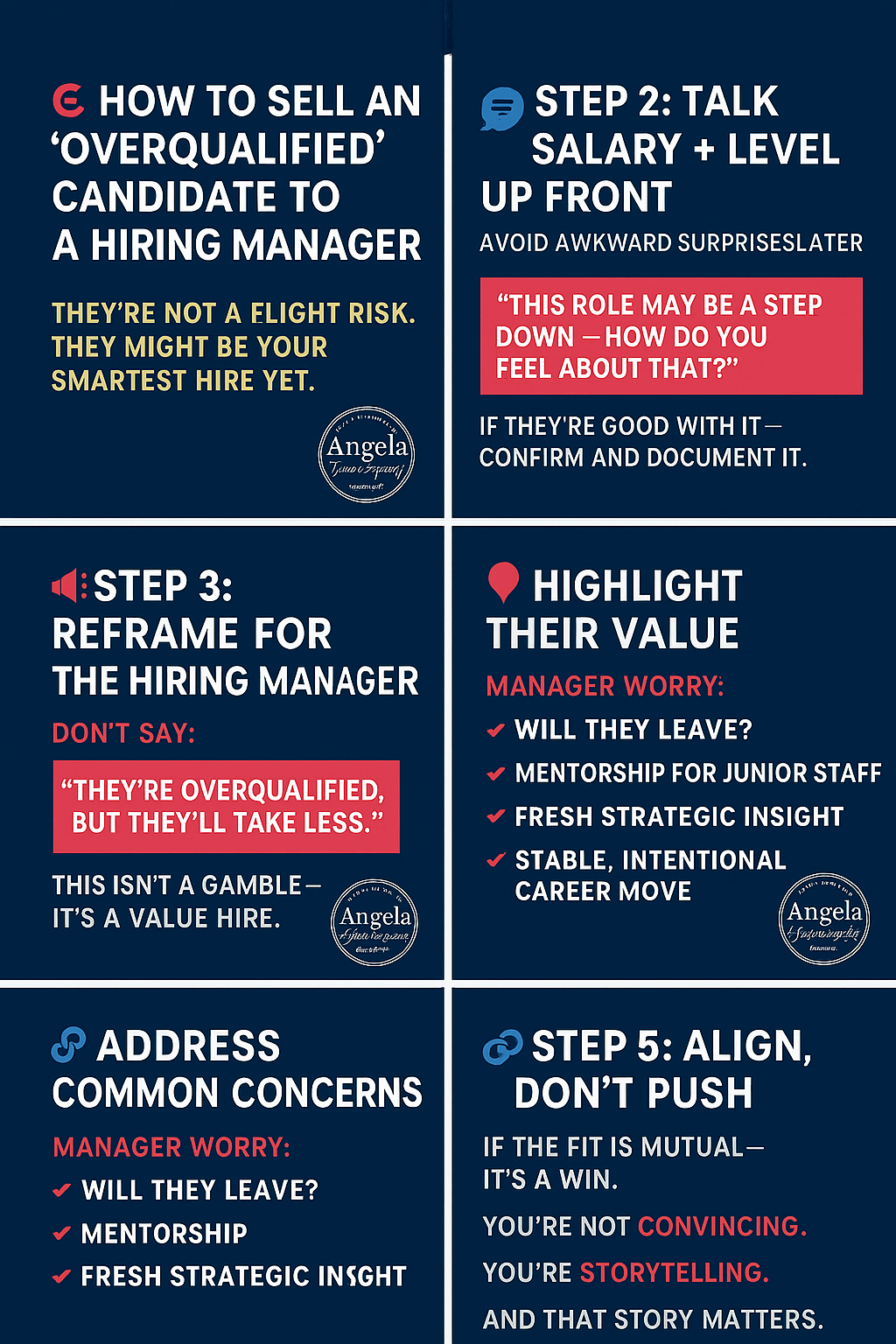
How to Sell an “Overqualified” Candidate to a Hiring Manager (and Why You Should)


As recruiters and talent advisors, we often hear a dreaded word when presenting experienced talent:

“They’re overqualified.”

Translation?
The hiring manager is concerned the candidate will get bored, won’t stick around, or is simply too expensive. But what if that “overqualified” label is actually a strategic advantage?

Here’s how to shift that narrative—and how to have the right conversation with the candidate to make sure everyone’s aligned before moving forward.


Step 1: Get Clear on the Candidate’s “Why”

Before you pitch a seasoned professional for a role that might look like a step back on paper, have an honest, empathetic conversation:

Ask the candidate:

  • What’s motivating you to consider this role right now?
  • How do you feel about the level/title compared to your last role?
  • What are your salary expectations? Are they flexible?
  • Are you looking for stability, mentorship opportunities, reduced stress, or a better work-life balance?

Many experienced professionals are making intentional decisions:

  • They’ve led large teams and now want to be individual contributors again.
  • They’ve done the high-travel, high-stress gig and want something more balanced.
  • They’ve had personal life changes that shift their priorities.
  • They want to align their work with a mission or product they care about.

Your goal? Understand why this role, now—and make sure their reasons are clear, realistic, and sustainable.


Step 2: Address Salary and Level Up Front

Here’s where things can get awkward if you avoid it—but powerful if you don’t.

Be direct:

“This role may come in under what you’ve made previously. Can you share what your current salary expectations are and how flexible you’re willing to be?”

If they’re open to a lower salary or step down in title, get that in writing (at least noted in your ATS). Transparency now prevents surprises later.

Be cautious if the candidate says “I’ll take anything”—dig deeper. Make sure the motivation aligns, or you risk a short-term hire.


Step 3: Reframe the Narrative for the Hiring Manager

Now that you’re clear on the candidate’s motivation and expectations, it’s time to present them strategically.

Don’t say:

“They’re overqualified, but willing to take less.”

Do say:

“This candidate brings deep expertise, but what excites them most is returning to hands-on work. They’re looking for a role where they can make an immediate impact without managing a large team or chasing titles.”

Focus on:

  • Speed to productivity: They’ve done this before—no steep learning curve.
  • Mentorship capacity: Great for junior team development.
  • Stability: If they’re shifting gears in life/career, they may stay longer than someone climbing the ladder.
  • Strategic value: They can bring insights that go beyond the current role.

💡 Pro tip: Position this as a “value hire,” not a compromise. You’re getting premium expertise at a practical cost.


Step 4: Tackle Concerns Proactively

Hiring managers often worry that the candidate:

  • Will leave as soon as something better comes along
  • Will struggle to take direction from a less experienced manager
  • Will be bored or disengaged

Here’s how to ease those concerns:

  • “We talked about that. They’re clear on their motivations, and they specifically want to contribute without being in charge.”
  • “They’ve worked under all kinds of leaders—they’re looking for collaboration, not control.”
  • “They’ve seen how stressful leadership can be. They want to focus on meaningful work and mentorship.”

Step 5: Align, Don’t Push

At the end of the day, the goal is alignment—not persuasion. If both sides are genuinely excited and aligned in expectations, it’s a win.

When handled right, “overqualified” becomes “highly qualified,” and what seemed like a risk becomes a strategic advantage.


Final Thought:

Don’t screen out someone just because they’ve done more.
Have the conversation. Ask the right questions.
Then present the right story to your hiring manager.

Because sometimes the best hire… isn’t the one climbing up—it’s the one who’s already been there and knows exactly what they want next.


Military Spouses, resume

Tailoring Your Résumé: Tips For Military Spouses

Writing an exceptional résumé can be challenging and does take effort to become comfortable with the process. Military spouses face additional hurdles when crafting a résumé due to constant relocations and potential lengthy gaps in employment. However, with a little creativity and exploration it is possible for military spouses to highlight their education, employment history, and life experience by creating a strong and competitive resume.

Tailoring Your Resume: Tips for Military SpousesChoose the Correct Résumé Format for You

Different resume styles are targeted to different career paths. For instance, if you are in a creative field, your resume can also be creative. If you are going after a government job, a more structured, “no frills” approach is more appropriate.

There are several résumé styles to choose from, including the following templates: chronological, functional, combination, and targeted. It is important to choose the right résumé style that best reflects your skills. For example, if you have large employment gaps or numerous short-term positions, perhaps you should consider using a non-traditional “functional” résumé or a “combination” résumé. A functional résumé is geared toward those individuals who want to highlight their skills and abilities rather than focusing on the time frame of each job they’ve held.

A combination resume also highlights skills and is great to consider for recent graduates and those with gaps in employment. It provides both a list of skills, as well as a chronological list of relevant employment history. This kind of resume can be easily altered for different applications to include keywords and phrases.

Finally, start each descriptive line of your resume with “strong action verbs,” to help highlight your experience and provide a list of descriptive terms so your future employer can understand exactly what you did. Below is a line from a military spouse resume:

Example: Bookseller at Bookstore X
Line 1: Provided excellent customer service by understanding store policies and search techniques
Instead of:
Line 1: Helped customers find books by searching the system and knowing the store’s layout

Although these two descriptions say similar things, the top is more direct and uses stronger verbs. Make your goal three descriptive lines for each job listing. More than that can lead to a very long resume. Ideally, unless it is a DoD-based resume, your document should be no more than two pages. Focus on capturing the employer’s attention and highlighting the most important aspects of your education and work experience. It can be a daunting task to start a resume, but once you create a comprehensive version, customize copies for each employment opportunity and simply remove the least relevant information for each job you are applying for.

Example: if you are applying for a service industry position, include other former service industry jobs. If you are applying for a Project Coordinator position, leave off your service industry positions, keeping the experience relative to your targeted job.

Example: if you are applying for a government position, most likely they will require a certain format and even a certain font. Look over the application requirements and prepare your documents accordingly. Often on-base employment services can help advise with government geared resumes in particular.

Include a Captivating Cover Letter

A cover letter is a must in today’s job market. You can have a remarkable résumé but if it doesn’t accompany a high-quality cover letter, it will most likely end up in the “NO” pile. A cover letter gives you the opportunity to introduce yourself and to highlight your skills relevant to the position. If you do a good job of relaying this information, hiring managers will more than likely take the time to review your résumé, giving you the chance to stand out among the applicants. The following tips are helpful to remember when crafting your stand-out cover letter:

  • Keep your cover letter to one page.
  • Address the cover letter to the organization you are applying to and modify the letter to reflect the position you are applying for.
  • Nothing gets your resume in the “no” pile faster than a generalized cover letter.

Be approachable but professional (i.e. tell them why you are excited to work for their company. Do not write about this one time in high school…)

Include Volunteer Experience and Trainings

To be a military spouse you often have to sacrifice your career goals, networking opportunities, or advanced education to support your service member. It is easy to focus on your employment gaps or compare yourself to other applicants with different circumstances. However, you may have much more in your application arsenal than you realize.

Community service, continuing education classes online, and even membership to groups can be attractive items on a resume or cover letter. For example, are you a member of the spouse’s club? Do you volunteer at the base’s thrift store? Did you attend a networking seminar or take an online excel class? Focus on the relevant skills you obtained and use them on your résumé.

Communication skills, leadership roles, and supervision experience are all examples of ideal traits that can be useful to any job regardless of where you obtained them. If you don’t want to list every position, you can make a separate section for skills, as in the combination resume.

Send Your Résumé to Military Friendly Organizations and Businesses

With a quick Google search, or through perusing other articles on this site, it’s easy to find an extensive list of businesses that value the dexterity and expertise that a military spouse can bring to their company. MetLife, US Bank, Starbucks, and Goodwill Industries are among the numerous companies that have pledged to hire military spouses. It’s always a good idea to send your résumé to employers that value your skill sets and who are willing to aid with the hurdles military spouses are likely to face.

Are You Prior Service?

Many military couples meet while serving together and one ends up getting out for a variety of reasons. If you are a spouse with prior service, there are a few things to keep in mind that will help you in preparing your resume. You may already have a government resume- if you are applying for a civilian government job, there could be very little you need to change. However, let’s say you were an MP and now you want to be an assistant event planner- you will need to rework your resume to target this new field and the next chapter of your life. Remember that your service, awards, and experience are important. Feature your awards or commendations on your resume. If you have certifications relevant to the position, list those in the education section. Even if it has been awhile since you put on that uniform, don’t sell yourself short.

Utilize the Career Office/Spouse Services

Although each installation varies, military bases offer many services to spouses including career exploration, available job listings and résumé help. Often underutilized, their supportive and free services are sure to benefit military spouses who seek their assistance. Not only can they help you create an outstanding résumé, but they also have a vast amount of experience working with the many résumé writing obstacles that military spouses face.

Yes, finding a job while being a military spouse can be daunting. However, with preparation, assistance, and endurance, you are sure to find the perfect job for you.

Originally posted by

Career Planning, Career Tests

What Is a Career Path?

Definition & Examples of a Career Path

Originally posted by the balance careers by Alison Doyle

We’ll review types and examples of career paths and how to develop a career path.

What Is a Career Path?

A career path is a series of jobs that help you progress towards your goals and objectives.

Your career path includes the jobs you’ll need to hit your ultimate career goal, but it doesn’t need to follow a straight line. There’s no blueprint or timetable for climbing the career ladder.

Career paths traditionally imply vertical growth or advancement to higher-level positions, but they can also include lateral (sideways) movement within or across industries.1

A Bureau of Labor Statistics survey of baby boomers found that they had an average of 12.3 jobs from ages 18 to 52.2 Changing jobs is expected, and sometimes those changes will involve different types of positions in various industries. Some career paths have a few ups and downs and some people even plan a move down the career ladder.

You might move down the career ladder by asking your company for a transfer to a position with fewer responsibilities and less stress. Or you might apply for a position with a company that you’re passionate about working with, but the only available positions are lower level ones.3

If you’re feeling stuck and unsure of the next step in your career path, consider talking to a career counselor. A reputable counselor can help you clarify your goals and explore your options.

Types of Career Paths

Career paths typically refer to either your path through an industry or your path through an organization. For example, if your goal is to become a principal, you’d typically start as a teacher and work on your administrative credentials while teaching. If you’re in a large district, you might chart a path within your district. You might become a department head and then advance to a position as an assistant principal.

If you’re in a smaller district, you might need to move to a different organization to advance your goals. In that case, your advancing within your profession, but moving to another organization.

Some organizations help you develop a career path as part of the employee development process.4 In this case, you and your supervisor or a human resources representative discuss your career development within your organization.

This discussion may take place as part of the performance appraisal process. Additional education, training, or work assignments may be planned to qualify you for subsequent roles within your career path.

Ultimately, your career path depends on your career values and personal goals. You might change industries as you pursue a higher income, better benefits, and/or increased job satisfaction. Or, you might wander off the path altogether to take care of family or continue your education.

Examples of Career Paths

To get a sense of your options, it helps to review examples of career paths for a variety of fields. Keep in mind that some career paths are direct and include specific jobs that move you up the career ladder and are typically followed in order.

Here are several examples:

  • Administration: Administrative Assistant—Executive Assistant—Office Manager
  • Advertising: Advertising Account Coordinator—Assistant Account Executive—Account Executive—Senior Account Executive
  • Communications: Public Relations Assistant—Public Relations Representative—Assistant Director of Public Relations—Director of Communications
  • Customer service: Customer Service Representative—Inside Salesperson —Outside Salesperson—Major Account Salesperson—Regional Sales Manager
  • Editorial: Editorial Assistant—Assistant Editor—Associate Editor—Editor—Senior Editor—Editorial Director
  • Education: Teacher—Curriculum Coordinator—Assistant Principal—Principal
  • Education to insurance (career change): Teacher—Insurance Salesperson—Trainer for New Agents
  • Engineering: Junior Engineer—Senior Engineer—Project Manager—Engineering Consultant
  • Human resources: Human Resources Assistant—Benefits Assistant—Benefits Specialist—Assistant Director of Human Resources—Director of Human Resources
  • Retail: Retail Sales Clerk—Assistant Manager—Department Manager—Store Manager—Regional Manager

Requirements for a Career Path

Some people have deliberate, well-planned career paths. Others take things one job at a time, adjusting as their goals and preferences change. Either approach (or a combination of the two) can be successful. Here are a few ways you can position yourself for a successful career path:

  • Be in learning mode: Today’s job market moves quickly. To keep up, you need to be prepared to add to your skillset. To find out which skills are most in demand in your industry, take a look at your peers’ LinkedIn profiles. You’ll learn which skills you’ll need to advance.
  • Network: Connecting with your peers can help you identify new directions for your career, even if you’re not interested in job-hopping at the moment.
  • Be flexible: Don’t hold too tightly to your career plan. Be open to opportunity and keep your ultimate goals in mind. What’s important to you? What do you enjoy about your job and career, and what would you prefer to minimize at your next gig?
  • Don’t be afraid of a lateral move: Sometimes you need to move sideways (or even backward) to get ahead. If a job offers you a chance to develop skills or connections that will be valuable later on, be open to a lateral move.

Military, resume, Veterans

How to Write a Civilian Resume

Original Posting by Military Onesource

Military Experience? Civilian Resume? - LucasGroupYour civilian resume is a summary of your background and experience, and it’s likely to be the first information about you that an employer will see. With your background of military service, you already have impressive skills and knowledge. These tips will help you make a resume that will stand out. Also, see below for links to resume building tools.

With a background of military service, you already have impressive skills and knowledge. These tips will show you how to write a resume that will stand out.

Collect your assets.

Get a copy of your Verification of Military Experience and Training through the Department of Defense.

  • Your VMET will give an overview of the skills you’ve gained in the military.

Make a list of your technical skills.

  • Computer technicians, mechanics and engineers have skills that can be easily converted to civilian jobs.
  • Convert your military job training into civilian terms. For example, “budgeting” is a critical skill in civilian companies.

Make a list of your intangible skills.

  • Include leadership, discipline and a strong work ethic.

Select your resume style.

There are different ways to organize your resume. Pick a style that highlights your strengths. Your resume should highlight your unique qualifications.

Chronological resume

  • Your employment history is highlighted, starting with the most recent position, and then going back in time.
  • Include your responsibilities and accomplishments under each separate job.

Functional resume

  • Your skills are highlighted. Your work history and gaps are de-emphasized.
  • Skills and accomplishments should be divided into specific areas of expertise.

Combination resume

  • Your skills earned in a variety of jobs are highlighted, but using a job history format.
  • Your specific skills will form the main body of the resume, followed by a concise employment history.

Include these essential components:

  • Contact information: In the heading, include your name, address, phone number and email address.
  • Objective or job target: In one or two lines, say what kind of job you’re looking or applying for, and what makes you uniquely qualified.
  • Summary of qualifications: This is a bulleted section just below the objective in the visual center of the resume.
    • Include five or six lines highlighting the skills that qualify you for the job.
    • This will include your experience, certifications and related training.
    • Title this section “Highlights of Qualifications,” “Summary of Skills” or “Summary of Experience.”
  • Employment history: Will vary depending on the type of resume.
  • Education and training: List colleges, schools or military training schools you attended. You can list the name of the school and the location, but not necessarily the dates.
  • Special skills: Include foreign languages, computer skills or any other relevant skills that will set you apart.

Make your resume unique to you.

You’ve got the basics down. Now use your resume to showcase your unique abilities and accomplishments.

  • Target your resume. Change and tailor your resume for the job you’re targeting. Learn what this employer looks for and highlight those qualities.
  • Translate everything into civilian terms.
    • For example, replace “officer in charge” with “managed.”
    • Take out the acronyms and use terms civilians understand. For example, replace “SNOIC for 2d MarDiv G-3, planning and executing all logistics for operations conducted in our AOR.” with “Supervised staff of 15 people. Planned and coordinated operations conducted by various subordinate units within our division.”
  • Include your accomplishments. Use numbers to highlight, if possible. For example, “Managed budget of $100K” or “Reduced training time from 26 weeks to 24 weeks.”
  • Be concise. Limit your resume to one or two pages.
  • Include volunteer experience if it’s relevant to the job. Volunteer experience can add to credibility and character.
  • Leave off unnecessary details. Don’t include marital status, height and weight or religious affiliation. Leave off salary information unless it was specifically requested.
  • Check spelling and accuracy. Proofread your resume, ask someone else to proofread it, and read your resume backwards to catch typos.

Write a cover letter.

Always send a cover letter with your resume. Your cover letter will explain why you’re interested in the position and how your skills make you the best choice for the job.

  • Get the name of the person in charge of hiring. Send your email or cover letter to him or her. Usually you can just call the company and ask for their name.
  • Mention the job that you’re applying for in the first paragraph. Focus on describing how your skills and abilities can help the company.
  • Keep it to one page. Use a business-letter format.
  • Always follow up. Mention that you will call to follow up and don’t forget to do it.

Tap into resume-building tools.

These websites have tools to help you build your resume and translate your military credentials and experience into civilian skills. They reference veterans, but they’re also for active duty.

  • Veterans.gov from the U.S. Department of Labor has an online job exchange with access to employers, skills translator, resume builder, interest profiler and more.
  • The Department of Veterans Affairs offers an interest profiler, educational and career counseling and links to other job resources, such as support for veteran-owned small businesses.
  • Resumeengine.org through Hiring Our Heroes provides an easy-to-use resume application to service members that will translate military records into a strong resume that civilian employers can easily understand.

Prepare for your job search early.

The earlier you can start your preparation for civilian employment, the better. The Transition Assistance Program office on your installation can help you get started. Military OneSource also offers the Transitioning Veterans specialty consultation to further assist you in transitioning from the military to civilian life.

If you’re pursuing federal employment, upload your resume to the federal resume-building websites. Visit the federal government’s USAJOBS site or your installation Transition Assistance Program for more information.

Career Tips, interview

The Ultimate Interview Guide: 30 Prep Tips for Job Interview Success

Original Posting: by The Muse Editor

Shutterstock

Preparing for an interview takes a lot more than Googling a list of common interview questions. You have to make a great first impression appearance-wise (no wrinkly suits here!), have a great knowledge of your target company and its product, and, of course, know exactly how to convey that you’re the perfect fit for the job.

So to help you get prepared, we compiled a list of our all-time best pre-interview tips. From strategizing about how to tackle the toughest questions to packing your briefcase, we’ve got you covered—with 30 ways to make sure you bring your A-game.

Spend a few hours learning everything you can about the company—from as many sources as you can. Talk to friends and contacts, read current news releases, and, yes, spend some time on Google. Often, candidates just look at the information a company is pushing out via the website and social media but fail to look more in depth at what others are saying. By doing so, you’ll get the larger picture about the company (along with any negative press).


Numbers 1-7
Know Your Audience

  1. Get a sense of “who” the company is and how to embody a similar personality during your interview. Start by reading the company’s blog and Facebook page—the tone of the company’s content on these sites will speak volumes. Or try reading individual employees’ blogs to figure out what type of people work (and excel) there.
  2. Twitter can also be an excellent resource because you can see what the company and its employees are talking about. Are they sarcastically bantering with each other? Feel free to throw a few jokes in as you’re meeting with people. Are they tweeting up a storm about an event or product launch? Use it as a conversation starter.
  3. No matter what role you’re interviewing for—engineering, sales, marketing—you should always use the product before your first interview (and ideally, a few times). If hired, your goal will be to create value for the people who use that product and being a user yourself is the first step.
  4. Make sure you reach out through your network to find current and previous employees you can talk to, too—they’re often your best source of intel on what it’s really like to work at a company.
  5. Before your interview, get a list of the people you’re meeting with from the company. Then learn more about them—including what type of behavior might intrigue them or turn them off. Finally, prep some questions that are specific to each interviewer: Ask for details about her focus at the firm, discuss current events on his specialty, or bring up a common interest you know he or she has outside the office.
  6. Different companies use different types of interviews, so ask what you’ll be faced with. For example, some companies will ask case questions or brain teasers while others will give a standard set of typical interview and leadership questions. Asking the recruiter or HR contact about the interview format ahead of time is totally fair game. And once you know, investing time to become familiar with this style can make a huge difference.

Numbers 8-16
Anticipate the Interview Questions

  1. Even if you’re a well-oiled interviewing machine, it’s essential to spend time thinking carefully about what skills, accomplishments, and interview answers will resonate with your interviewers most. Your management abilities? Your creativity? The examples you share will probably be slightly different everywhere you interview.
  2. Have an answer to “Tell me about yourself” ready to go. Interviewers always ask it, and you want to be sure to nail this first part of the interview.
  3. Don’t be thrown off by the classic “What’s your biggest weakness?” One foolproof method: Think of something that you struggle with but that you’re working to improve. For example, maybe you’ve never been strong at public speaking, but over the past few years, you’ve taken on leadership roles and volunteered to run meetings to help you be more comfortable when addressing a crowd.
  4. You can easily find lists of common interview questions—but don’t prepare by writing out your entire answer; instead, jot down a few notes or bullet points and keep them on hand for the interview itself. You’ll ensure you cover the bases—without reading from a script.
  5. Don’t forget about the numbers! Finding some numbers, percentages, increases, or quotas you can use when talking about your responsibilities and accomplishments really sweetens the deal and helps you tell a hiring manager why you’re so awesome. (Here’s how to include them, even if you don’t work with numbers.)
  6. It’s likely you’ll get asked why you’re interested in this particular role and company. (And if you can’t answer this question, you shouldn’t be in the interview!) So to make sure you can, consider why you’re interested in the function and identify a couple of key factors that make it a great fit for you and how it aligns with what motivates you (e.g., “I love customer support because I love the constant human interaction and the satisfaction that comes from helping someone solve a problem”).
  7. Don’t just think about how you’ll answer certain questions; practice looking in the mirror and answering them out loud. This prep work will help you clarify your thoughts and make you much more comfortable during the interview.
  8. Do as many mock interviews as you possibly can with a friend. You’ll be much better at answering, “What would you bring to the position?” the 100th time you do it than the first, right?
  9. Prepare a few smart questions for when it’s your turn to ask. Make sure they’re thoughtful ones that show you’ve been paying attention and have done your homework when it comes to researching the company and the specific job you’re after. Try these!

Numbers 17-24
Pack (and Dress) Accordingly

  1. Plan the perfect interview outfit. For companies that have a business or business-casual dress code keep your look basic and conservative for the first interview. Not sure what to wear? If you have a contact or friend who works at the company you’re interviewing with, see if he or she can give you a heads up as to what people wear. If you don’t have that luxury, scope out photos on their social media (or their Muse profile!), or hang out at a coffee shop across the street a day or two before and try to get a glimpse at what people are wearing.
  2. Make sure you get your outfit cleaned, pressed, and tailored (a modern fit is best). People often have their “interviewing suit” that’s been sitting in their closet for the past couple of years, and they dust it off for the occasion—you don’t want to be that person.
  3. Don’t forget about the little things: Shine your shoes, check for loose hems, and make sure your fingernails look manicured. This is the stuff that you don’t always think people notice, but they do!
  4. Do a little pampering, because looking your best helps you feel your best. If that means you need a facial, haircut, razor shave, or even a new interview outfit, then by all means do it! Feeling good about yourself will boost your confidence—and we probably don’t have to tell you that confidence is key to landing your dream job.
  5. Print out five copies of your resume. You never know who you’ll be meeting with, and you want to have your resume ready to go in case you’re asked for it.
  6. Prepare a reference list, whether you think you’ll be asked for it or not. For each reference, include a name, title, organization, division or department, telephone number, and email address, as well as a sentence briefly explaining the relationship (e.g., “Carlton was my team leader for two years, during which we collaborated on four major product launches”).
  7. Prep your your purse, backpack, or briefcase. Whatever bag you carry should be large enough to hold your everyday essentials, plus your interview musts, such as extra resumes and a notepad, as well as a special emergency kit stocked with what you might need in an unexpected situation (think: Band-Aids, a stain stick, an umbrella, and breath mints). Here’s a general checklist of what to bring to an interview so you’re super prepared.
  8. Clean out that bag! If you have to dig past candy wrappers, phone chargers, and old receipts to get that resume, you’re going to look a little unorganized. Everything you need should be neatly organized and readily accessible. The less you have to rifle through your bag, the better.

Numbers 25-30
Get Your Head in the Right Place

  1. Spend the most time before the interview not rehearsing questions but reflecting on your career chronology to date. When you know your story inside and out, it’s much easier to apply examples to just about any interview question.
  2. Getting ready for a technical interview? Start preparing as early as possible. Working through a prep book or sample questions will not only give you good practice, but it’ll also put you in the right problem-solving mindset.
  3. Come up with a go-to phrase that’ll help you avoid dead air if you need time to stall and gather your thoughts. Two strategies that work well are repeating the question thoughtfully before answering or saying (slowly), “Now, that is a great question. I think I would have to say…”
  4. Brush up on what certain body language conveys. Be aware of what you’re communicating through your posture and stance—and make sure it’s good. (For example, sitting with your arms and legs crossed sends a message that you are closed-off or feel defensive.) Think your movements through ahead of time so you are not distracted (or distracting) during the interview.
  5. Use an interview cheat sheet to compile all the details you need to remember, jot down notes about what you want to say and ask, and check off all the essentials of what to bring to the interview. Print one out for every interview, read it over the morning of, and you’ll be good to go! (We made one for you right here!)
  6. Oh, and get some sleep. This sounds like something your mom would tell you, but there are few things that will throw you off your game like sleep deprivation.